Saturday, 23 April 2011

Day 22: Ghana v England


Another bright and beautiful morning and Elisabeth and I set off for Galillea. We joined a primary 4 french lesson to start, and when the teacher had to unexpectedly leave early, we jumped at the chance of continuing for him (rather than letting class prefect Kamal take the class). After we helped with the French class Kamal told us it was now time for English. As the teacher did not appear, we opened up the books following on from their last lesson, and began to teach them about verbs and adverbs and the differences.

After break it was time for Maths, Kamal informed us that the Maths teacher had told him the class should simply revise. Perhaps he knew the two obrunis would take over, and we happily did. Elisabeth presented a neatly drawn number line including fractions and decimals. I then incorporated percentages, and began teaching on how to change fractions to percentages to decimals. Interchanging all three was at first confusing to the enthusiastic primary 4 class, but the children soon caught on and hands were flying up to come out and write the answers on the board.

Considering I had observed numerous lessons in my previous weeks, I decided assigning some classwork would be appropriate, and set out some questions. There was clearly a broad range of ability within the class as some of the children had finished the questions in a few minutes while others were still struggling at the first question. It is this vast range in ability that I have found one of the hardest to overcome when trying to teach an Omega class. In Britain, teachers are instructed to teach to the highest ability children, so they are not sat bored in the classroom. Whereas in Ghana it seems the teachers teach to the lowest ability children, leaving any who find the work fairly simple the task of putting their heads on the table. This constant waiting for the less able in the class is seriously damaging the progress that some of the higher ability students could be making and is something which should be addressed.

Following our interesting Maths lesson we were faced with the daunting task of trying to teach Citizenship, which neither I nor Elisabeth had a real clue about.  However, the textbooks provided were fairly self explanatory, which allowed the two of us to work out what we needed to teach. The topic was communities, something which I believe to be a central part of most Ghanaians lives. With hundreds of small communities in the Kasoa area alone, each having different aspects and characteristics. We then discussed what the childrens own communities needed, the most common answers included; better roads, cleaner streets and a larger market.

After school we headed to the bank and bumped into Ken, David and John, and managed to get a cheeky lift of Ken to Kasoa for my mini project research. Unfortunately, the lights had only just come back on when I arrived, and so the kids had already gone home on the school bus. I will return on Thursday and hope for a more successful outcome.

The evenings entertainment was provided but the much anticipated friendly football match, Ghana v England. Marc Beas had set out all the chairs they owned in front of their projection screen in anticipation of the large crowds. The game was evenly matched throughout and although England went up a goal in the first half, Gyan (Sunderland player and now hero of Ghana) equalised in the 91st minute. The whole place erupted in cheers of delight, with viewers running up to the screen in excitement. It might have only been a casual friendly to the English, but to the Ghanaians it seemed like an epic victory, and I was happy to be wearing a Ghana t-shirt. Final score Ghana 1 - England 1!

Friday, 22 April 2011

Day 21: Phonics Frenzy

Another new week and Elisabeth and I had planned to visit Galillea, the only Omega school in the area that we had not yet seen, and the school that Ken’s son Nevis goes to nursery. Picked up in the morning by Ken and Nevis, it was clear Nevis was not awake enough to entertain some scary Obruni girls, and after shying away at the sight of us he managed to fall asleep on the bumpy ride to school.

Next to Lake Weija, the small somewhat secluded school is nicely painted and neatly laid out. With a makeshift stage for morning prayer and singing, a large area of land to march in, along with the standard courtyard playground within, on first observations I had high hopes for this Omega school.  Showed around each class by Mary the school manager, the children were friendly and greeted us warmly, with some of the teachers remembering us from the phonics training session with Miss Sofia.

As another Omega school with a computer lab I was keen to start the day by observing an ICT lesson. As usual, peer learning was key, as there were around 3 children to each computer, each taking it in turn to complete the task assigned to them (Sugata Mitra would have been proud of the independent learning through discovery and trial and error).

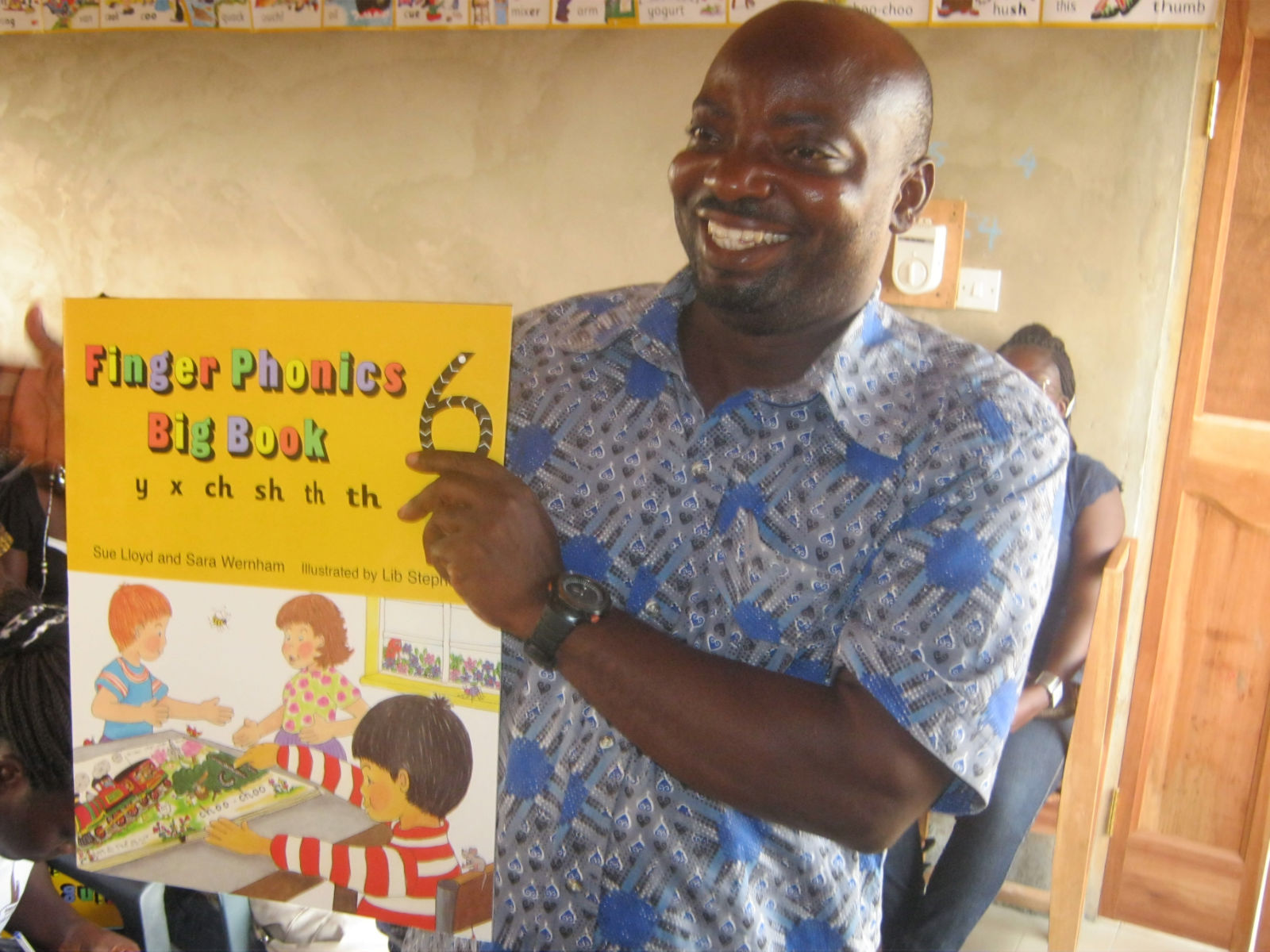
After ICT we joined some of the younger classes, who had embraced the Jolly Phonics scheme. The KG2 teacher was clearly listening at Sophie’s training as she had followed the exact structure of the Jolly Phonics teaching book, and had already managed to teach her class the letters in the first book. Elisabeth and I were inspired by this progress and decided to incorporate some of the activities we had seen Sophie do with her class at 94. Human words were tackled and conquered by the majority of the class, and a game of noughts and crosses even went surprisingly well. The Nursery  2 Class had also been learning phonics post teacher training, but the teacher had done it alphabetically rather than following the jolly phonics system.  As the children were younger our attempts at a short teaching lesson were not quite as successful, but it was still excellent that the teacher was willing to try and incorporate the phonics system into her daily routine, and it clearly shows that the majority of teachers would be happy and willing to learn new techniques to enhance the education of the students.

With no teacher in the p5 class during the ICT crossover Elisabeth and I stepped in to help guide an English lesson using the textbooks provided (due to the large classes and the small ICT room, they must take it in turns to use the computers and have a teacher.) We must have done a good job, as the kids were keen for us to continue on into the next lesson, unfortunately for them they were scheduled to have a rather taxing maths test, so Elisabeth and I slipped out to find Mary and sort out some lunch. After an almost endless wait we were served jollof rice, what we guessed was goat and a boiled egg. However we were slightly put off our food by the disturbing display of punishment being administered by the Primary 2 teacher. This was the first time we had witnessed actual beatings and it was horrifying. The teacher was demanding the children position their hands out in front of them with their palms facing up while she caned them. Elisabeth and I were astonished by the teachers harsh attitude to the children, and although many teachers we had seen were strict with the kids, this was the first time we’d witnessed any physical punishments, I truly hoped it was the last. And I fully believe this is not the custom held throughout the Omega chain and that this was just a slight glitch in what has been a fine display of educating.

The topic of conversation that evening turned to the depiction of Africa on TV, for instance on Comic Relief, compared to real life Africans. Having been in Africa for  3 weeks now I believe the images on TV do not accurately display how the average African or at least Ghanaian really is.  Ghanaians are proud happy people, they work hard to earn their keep. The only beggars I have seen have been physically handicapped, otherwise I would say begging is almost frowned upon, that Ghanaians are better than that.  Of course there are those in a severe state of poverty and organisations like Comic Relief are more than welcome to assist. But I feel there has been a smokescreen created by the media, in reality not all Africans are as incapable and helpless as most people might have believed from what has been shown countless times on TV.

Sophie’s day was just as adventurous as mine and Elisabeth’s as she had gone on an eventful trip to the post office with Gad (one of my Mini Project kids) as her tour guide. Gad didn’t have a cedi to go to school that day, and ended up bumping into Sophie in the street. The carefree kid took Sophie all round Kasoa to find a stamp and then a post box, for all his trouble Sophie let him lick his first stamp and post his first letter. It’s amazing to think that something as simple as posting a letter could be such a momentous occasion for a child in Africa.

Sophie’s day was just as adventurous as mine and Elisabeth’s as she had gone on an eventful trip to the post office with Gad (one of my Mini Project kids) as her tour guide. Gad didn’t have a cedi to go to school that day, and ended up bumping into Sophie in the street. The carefree kid took Sophie all round Kasoa to find a stamp and then a post box, for all his trouble Sophie let him lick his first stamp and post his first letter. It’s amazing to think that something as simple as posting a letter could be such a momentous occasion for a child in Africa.

Thursday, 21 April 2011

Day 19 & 20: Big Milly’s Big Weekend!


After finally being allowed to get a taxi for 8 cedis by the crazy old security man who sits outside Marc Beas, Sophie and I joined the others at the renowned ‘Big Milly’s Backyard’ and began our big weekend.

Friday night: Having been called by Elisabeth earlier to pre-order our food both Sophie and I had gone for the BBQ’d Tuna, finally something that wasn’t chicken and rice! Dinner in Milly’s backyard almost felt like being back in England (but warmer) as the amount of Obruni’s staying at Big Milly’s was unreal, clearly we’d come to one of the most popular tourist attractions in Ghana.

After dinner entertainment involved acrobatics (including children - I was surprised Elisabeth didn’t run out to ask them questions about the work they did), fire eaters, contortionists and the main event of drumming and african dancing. In which Elisabeth and I were both embarrassedly brought up to imitate some african dancing. The evening was enjoyable for all and it was nice to have a cheeky alcoholic beverage before bed.

Saturday meant one thing to Elisabeth, Sophie and I...time to tan! With the beach only minutes away from our hostel we set out our towels and began to lap up the sun. However, Paul and Simiao were not as keen for the constant sun exposure, and so left to go for a wander around the area, and to have shower number two of their 7 showers in a day (Shower Gate ’11). Elisabeth the serious tanner managed to last a lot longer than Sophie and I, who decided to frolic in the sea for a large part of the day, taking on the treacherous waves and uneven sea bed.

After i could stand the sun no more i returned to the room to invade shower gate, leaving Elisabeth and Sophie (Sophie in particular) to obsess over the beads being sold on the beach. Beads, beads, beads, they were everywhere, especially in Sophie’s newly named bead bag.


Saturday evening at Big Milly’s brought reggae music and dancing for our viewing and listening pleasures. I have found a definite new love for reggae music, but I’m still convinced that ‘No Woman No Cry’ can be sang to all reggae song tunes. We were also joined by Ken, Lisa, Nevis and Abigail (a Junior High girl who stays with them) for dinner, considering it was Paul and Simiao’s last night. Ken gave us a lot of insight into the Omega chain, how it all began and what his future plans were for school business. He was clear that appearance and word of mouth were key for keeping his business healthy, and that is why he has made sure all the school buildings are properly built and appear in good condition. He told us of his adventurous targets; aiming for 6 more schools by the end of this year, then intending to have 50 schools in Ghana by 2015. Although bold visualisations, I have no doubt that if Ken works as hard as he has on the current 7 schools he has, he can achieve his goals.

As the others felt the effects of a day in the sun and returned to the room, Sophie and I lapped up the weekends freedom and got talking to two interesting German boys, and were later joined by a lot of crazy Ghanaians. The conversation lasted until the wee hours of the morning and got more and more ridiculous the later it got. Antics included mine and Sophie’s attempt at creating a new language due to my lack of linguisitic skills, the fire eater trying to teach me Twi and one of the whispering acrobats wanting to whisk Sophie and I to a far away land.  4am signalled bed time and although Sophie was keen to sleep on the beach I was much more inclined to wake everyone else up (due to the inconveniently locked door) to make it to my bed.

After having approximately 4 hours sleep when the others suggested going to see the monkeys I had to decline and luckily Sophie also had no real chance of being ready in time. The others ventured off to see one singular monkey, while me and Sophie relaxed rasta style...i think i want a dread. With the weekend at an end, it meant it was time for Simiao and Paul to leave...for good. We said our farwells at Big Milly’s allowing Simiaio and Paul full reign of the shower back at Marc Beas. Me, Sophie and Elisabeth spent the rest of our day relaxing around Big Milly’s and perusing the stalls (Elisabeth and I slyly buying Sophie a birthday present.)


Once back at Marc Beas it felt strange no longer having Simiao and Paul around, suddenly 3 people seemed like a rather small group. I spent that evening getting accustomed to my new room, and watching some TV. The Ghanaian version of ‘Who wants to be a millionaire?’ was on, alternatively named ‘Who wants to be rich?’ Before the break the programme advertised a new version of the show which allowed children aged 8 - 14 the chance to go on the show with their parents to win up to 50,000 cedis worth of school vouchers. Another way of advertising education, and a clear sign that education is almost seen as a prize in Africa. I felt the concept was fairly impressive as rather than just winning money which a child or the parents may spend frivolously, school vouchers only have one use, and they could seriously change a child’s life, setting them up with years of fine quality education.

Wednesday, 20 April 2011

Day 18: Odupongkpehe

Returning to the government school Odupongkpehe from yesterday, and after researching the Bible verse and completing my homework, I was sad that the headmistress wasn’t in a preaching mood and did not test me on my ‘book of life’. Instead she had organised interviews with the Junior High 2 class for Elisabeth and I, which ran rather smoothly. From my interviews I found that this government school had the best selection of sports I had come across so far, including; football, volleyball, handball and netball. To which they actually brought in teachers from other schools to coach after school. The girls told me that when they had a match coming up, they would often train after school everyday, and looking at the facilities around the school there was plenty space and a large playing field just behind the school. I then managed to find one of the teachers who coached the school football team, and had a brief interview with him.  His main concern was that the Kasoa area only had one local park and as it is a community park it made organising school sports a very challenging prospect. He was very helpful with all the questions I asked and was clearly not afraid to voice his own personal opinions on physical education and sport which was extremely refreshing.
When questioning the government school children I noticed that they were on average a few years older than the Omega ones. Many were 18 or older, and still had Junior High 3, and 3 years of senior school to complete, compared to the 15 and 16 year olds in Omega’s JH2 Class. The older age must make finishing school and going on to further education a much harder and economically inconvenient prospect. At 18 many of the children still at school would be considered in their households as an adult, and when a family may be struggling to put food on the table, it is no wonder over 70% of children work after school and at the weekends to help support their families. If the oldest child of a large family there must also be a lot of pressure on that child to work and contribute to the welfare of the family, and being at school limits the time that could be used to work and make money. The older the child gets makes it more and more unlikely that the parents would be willing or would have the resources to continue to support the child through school, and so the child must either work independently to make the money to attend school, or forgo school all together and concentrate on working and making money to survive. Therefore, even finishing senior school in Africa must be an achievement, and those that go onto University must be seriously motivated and have some form of wealth necessary to pay for fees and materials.
While I was discussing sport with the Science teacher, Elisabeth managed to find out about how the government school was run in comparison to Ken’s Private Omega chain. The supposed ‘free’ government school may not charge the children an entry fee, instead the children must buy their own school books, pay a PTA charges and possibly pay more hidden charges undisclosed by the headmistress. If they cannot afford the textbooks then they must go without, unlike at Omega where there are sufficient amounts of textbooks stored in the School Offices available for each class to take when required. Odupongkpehe was also a government school which worked on a morning and afternoon rotation system, where children in the lower primary levels would only come in for the morning or the afternoon, and not receive a full days education, due to the over-subscription to the school. At Omega the children are not provided with one warm meal a day and unlimited drinking water, at Odupongkpehe the children must buy bags of water and food from the school tuck shop. However, the school had recently incorporated a ‘Food for Education’ programme, an astute plan which gave children more incentive to attend school by giving them a free lunchtime meal. 
After Odupongkpehe I headed to Kasoa accompanied by the ray of sunshine that is Miss Sophia, to continue on with my mini project. Today lights were on and work was running smoothly. Sophie was a enormous help and managed to alleviate some of my pressures by assisting numerous children in replying to their particular pen pal. Once finished, Sophie and I headed back to Marc Beas to pack for our weekend ahead at Big Milly’s Backyard in Kokrobite.
Small Point: I also moved in with Sophie and Elisabeth today, as Simiao is leaving me (sad face). Exciting times ahead sleeping on a double mattress...on the floor.

Tuesday, 19 April 2011

Day 17: The book of life

This morning Elisabeth and I  had no specific school to attend, so took a well deserved lie in. Unfortunately for us, our attempt at an afternoon tanning session was thwarted by the distinct lack of breeze outside Marc Beas, creating an impossibly hot environment for us to sunbathe in. Instead we resorted to planning our next strategic move for visiting and assessing more government primary schools. As we were going to 94 later in the day to help Sophie with her phonics training session, we thought the wise choice would be to find some some of the government schools in the kasoa market area near 94.
Back to our usual tro route making our way to Kasoa was much easier than our previous days of travel. Once through the market, we knew there were definitely government schools nearby as we had frequently seen the kids walking around the market. But we could see no signs directing us to the actual location of the school. With luck on our side, one of the girls (Esther) from the Junior High 2 class recognised me and shouted out ‘Miss Tutu, Miss Tutu, how are you?’ and once we’d cleared up why she wasn’t at school (some sort of sore foot, which oozed the same purple liquid that was put on Miss Sofia’s toe when she tripped) she offered to show us where the nearest government school was. Thinking it would be a quick 3 minute walk, Elisabeth and I followed on closely behind Esther. Instead we were taken on a mammoth journey, worthy of those taken by Tooley in the Beautiful Tree, snaking in and out of dirt tracks, side streets and sewers. 
Finally we made it and were welcomed by the headmistress of Odupongkpehe Government School who although agreed to us returning the next day to carry out our research was highly suspicious of Elisabeth’s questions on children working, thinking she was here to expose the horrors of child labour. Once we had fully assured the head teacher that our findings would simply be for our university dissertations, she sat us down for a verbose discussion concerning religion. Although neither of us are strong believers in Christianity, it seemed a lot simpler to agree with the headmistresses preaching. She had the wholehearted belief that the end of the world was coming, marked by the recent earthquake and tsunami in Japan, and the current fighting occurring in Northern Africa and the Middle East. A seriously rash statement , but who am I to question her beliefs. Unfortunately, as we had claimed to be Christians (and own Bibles) she gave us a verse of the Bible to read before our return the next day. 
Along with our homework, the headmistress also gave us some insightful chat about the competition between public and private schools. She maintained that public schools had better resources due to the money awarded to them from the government, and although they did not have a computer lab like some of the Omega schools, there was a conveniently placed public library which was available to all the students. She also believed the teaching was more advanced in government schools due to the higher qualification of the teachers, which is a fair statement, but after watching one of the older classes and seeing over 70 children crammed into one lesson, perhaps a less qualified teacher with a smaller class would work better than a qualified teacher with an unmanageable class.  
As we had only visited primary schools (with junior high 1 and 2 classes) we were intrigued to find out what happened after this in the senior schools (to which Omega have not quite got round to creating one...yet). Once again, the headmistress enlightened us with her own opinion that once the private and the government children come together at senior level, the private school children would be ahead in the first term, but after that the government students would overtake them and continue to flourish and achieve higher results than those who attended private school.
Strangely enough, there was another government school (Zion) right next to this one, and so the headmistress directed us to where we could find the head teacher of Zion school so we could further our research. Considering the close proximity of the two schools, I did wonder why the government didn’t place one school in a different district to allow more children access to a school. Unless it was placed there due to the large mass of children within the area needing to go to school, in which case it may be perfectly feasible. We found the head masters office, and in true ‘Beautiful Tree’ style, he was asleep at his desk. Once awakened he obligingly directed us to the staff room, where we could conduct our research questions. He even provided us with a somewhat unnecessary translator, a teacher who merely repeated what we had asked the children but in a louder more harsher tone to try and force a quick answer. Although there to help, I felt the added pressure from the teacher simply made the children rush and say what they thought was the correct answer, rather than how they actually felt.
Once finished we headed towards 94 to assist Sophie with her Phonics training. The Kindergarten and Lower Primary Teachers of all 6 of the Omega schools in travelling distance were all present and the training ran smoothly. The plan to implement phonics into the early years of primary is an excellent idea as it finally gives the children the tools to read, a vast improvement on the current rote style teaching method. Ken and Andrew were both in attendance and are clearly very keen to include phonics in the Omega schools curriculum, to further boost the quality of education they are providing. Their clear enthusiasm and efforts towards better education is inspiring and portrays why the Omega chain is becoming a household name in Ghana.


Before heading home we got to meet Ken and Lisa’s (who works in the office at 94) ridiculously cute but very shy son Nevis and Ken’s niece. Once home i obviously felt the need to get right onto my homework so went to investigate what Revelations 20:12(the verse given by the headmistress) was all about.
Revelations 20:12 - ‘And I saw the dead, great and small, standing before the throne, and books were opened. Another book was opened, which is the book of life. The dead were judged according to what they had done as recorded in the books.’ - So basically the headmistress was reinforcing her point that the end of the world was coming, and telling us that we were all going to be judged.  Leaving me to contemplate my book of life, not really what I would call bed time reading.

Friday, 15 April 2011

Day 16: A tro tro a day, keeps the rabies dog away


After yesterdays failure to secure a tro tro to school we were determined to make our way onto one today, and against all odds we squeezed onto one fairly promptly (ignoring our British need to queue...finally). On tro ride today was a perfect display of good tro etiquette. Our fellow travellers helped us pay, made sure we got off at the right stop, and even when i dropped 10 pesewa (a simple 4 pence) which i was willing to leave behind due to the serious inconvenience of trying to pick it up off the tro’s floor, was handed back to me through the window  once i was already off. The Ghanaians are truly remarkable in how honest and helpful they are to Obruni and to each other.
However, bad tro points must be given to the near collision between a little girl running to get onto our tro and a motorbike riding up the invisible inside lane and the church sermon given on our tro ride home. The hand flailing, shouting,  somewhat angry man reciting the bible in Twi, did nothing for me. Although the majority of Ghanaians may be Christians, there are a high percentage of Muslims, and to impose a religious sermon on public transport would be unheard of in Britain. Ghana is clearly different, as not only was the sermon allowed and fairly well received, the god fearing man got a free ride.
On our arrival at the Government school, the headmistress who we had met the day before and arranged the visit with, was no where to be found, not a good first impression on the management of Government schooling. Luckily for us another teacher showed us around and sorted out some children for us to interview and so we were all set. Even with a football pitch within the school compound the boys i interviewed told me they were not actually allowed to play football during the school day. So clearly physical education was not an integral part of this government schools curriculum, and was specifically seen as something to do after school or at the weekends. As we were leaving the school i noticed 2 deflated footballs in the store cupboard, which reinforced my ideas that sport was not perceived as an important part of education. Our first visit to a government school had been eye-opening, having read the many articles by Tooley and Dixon about such incidents in public schools, it was enlightening to experience firsthand how lack lustre some of the staff can be in comparison the the private sector.
From the government school, i had to venture all the way to Kasoa school to continue on with my mini project. As the Benton Park children had sent emails back to the Omega children, things we finally running smoothly, and i had children paired up, ready to begin their pen pal journey. Thankfully, the power stayed on, and all the children managed to either sort out their email address or send an email back to their own individual pen pal.
The evenings entertainment involved Elisabeth and I daring to try the phantom kebab; perhaps goat, perhaps rabies dog...who knows? In the end it turned out better for us, as the chicken portions that evening for Sophie and Paul were not the usual succulent leg and thigh and instead consisted of some sort of deep fried bones. The food in Ghana is an adventure in itself. Fed(technically) and watered we headed upstairs to enjoy another air conditioned nights sleep (which i think has been working slightly too well, as i have now woken up cold a few nights in a row! Cold, in Africa, craziness!)

Day 15: Omega One Cedi


This morning Elisabeth and I realised we were no longer tro pros when going the other direction to school, as we failed to push our way to the front or get involved in the morning tussle and bussle work run. Instead we waited patiently in what we thought was a typical British queue, to realise it was actually a free for all, and had to settle for a 2 cedi taxi to our required destination.
Oblogo school, the heart of Omega school sport, winning both the girls and the boys football tournament between the Omega chain. Having a large football field next door to their school must give them a slight advantage on the other schools’ mere dusty concrete courtyards. Having seen both trophies displayed purposefully and proudly in the school managers office, i was intrigued to find out how football fitted into the schools routine. And after a few interviews it was clear that Mr Isaac was the man to go to, as he took football training at 5am(yes 5am!) on a Saturday morning for the kids at Oblogo. From my questionnaires, it was clear that the majority of the boys and girls enjoyed having access to the football field, and regarded football as their favourite sport.
The road home from Oblogo was lengthy, which allowed the many street dwellers to call on the Obrunis for a small chat. The local hairdresser wanted to give us her baby, and naturally wanted the oh so sacred ‘invitation’ to Britain, claiming she had many white friends to visit. We were also called over to what seemed the British equivalent to ‘ladies who lunch,’ to explain to them what we were doing. After speaking with them, it was clear ‘Omega one cedi’ was a household name in this area, as although we had walked a fair distance away from the school now, each lady knew all about the promising low-cost private school. The African way clearly involves word of mouth and the opinions of the general public, because that is how people will find out about the school and that is how it can grow into a competitive school within the vast market.
On the long walk to the main road, we also passed a large government school, and decided it would be excellent for our dissertations and our general perceptions of schooling in Ghana to have a look around and hopefully undertake some questionnaires. As we entered the school it was unclear where the headmaster/headmistress’ office was, as there were several classrooms, some with teachers, some without. We soon asked one of the teachers sitting outside, and were showed into a small room at the back of the older classes.  The headmistress seemed fairly strict, but agreed to letting us come and interview children tomorrow at 7.30am, so as not to disturb lesson time. As we were leaving i noticed a board on the wall with the names of all the teachers and their qualifications, having not seen that before in any of the omega schools i was intrigued, perhaps the teaching standards would be higher? We will have to wait and see tomorrow.